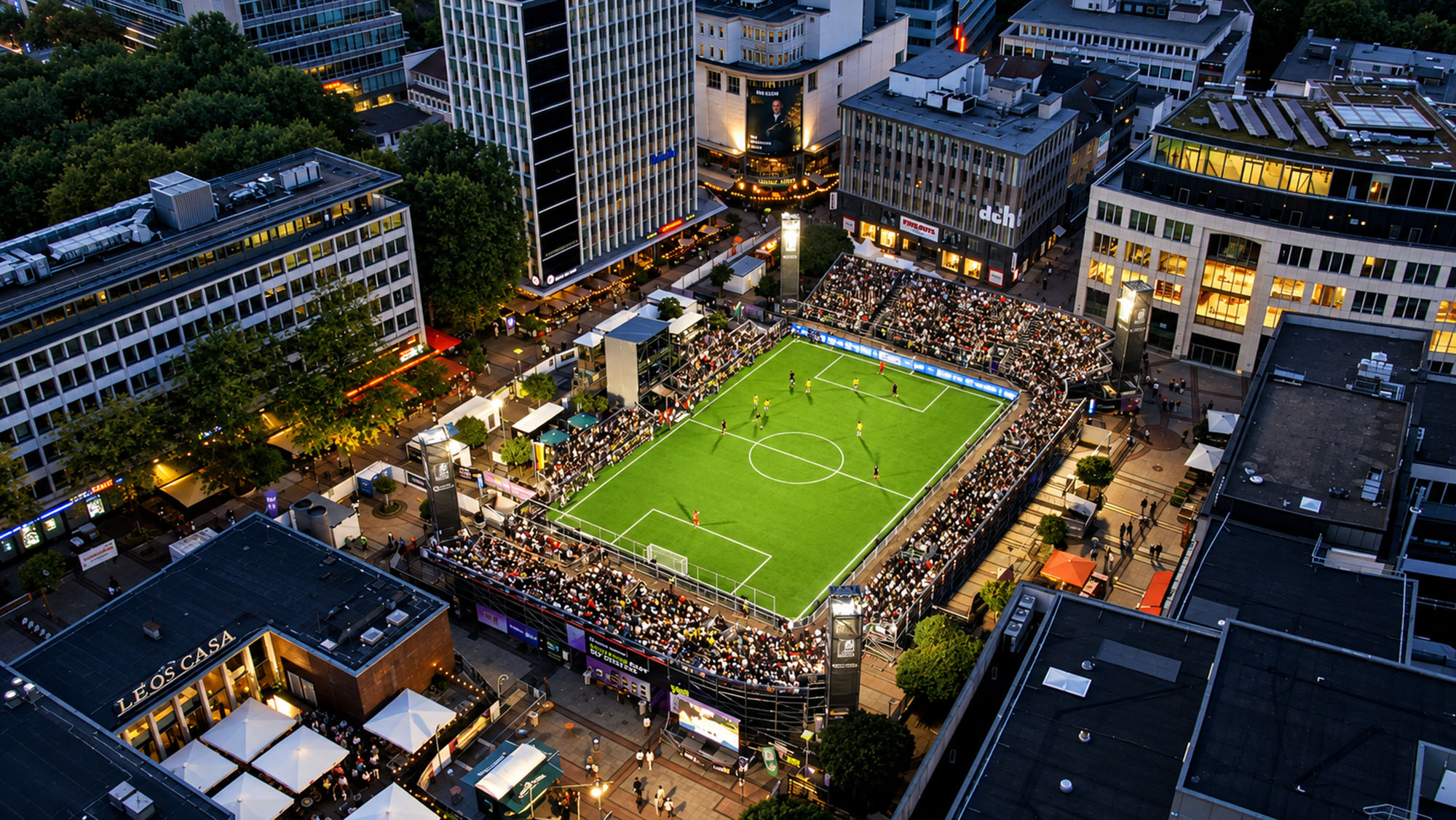
A temporary football pitch in the heart of Essen, Germany
For ten days, Kennedyplatz in the centre of Essen, Germany, became an international football stadium. For the 2026 SOCCA World Cup, a temporary stadium was constructed in the middle of the city. Forty eight national teams from six continents came to Essen for ten days of international small sided football. At the centre of the stadium was a Pure PT™ playing surface supplied by TenCate and installed specifically for the event.
It was an unusual setting for a football pitch. Unlike a permanent sports facility, everything had to come together within a defined event schedule. The stadium was temporary and so was the pitch, but from the moment competition started, the playing surface had to meet the demands of international football.
Performance from the first match
Small sided football is fast and technical. The compact playing area means players accelerate, brake, turn and change direction frequently. Ball speed, bounce and roll are equally important to the way the game develops.
Pure PT™ is an infill free turf system developed around the interaction between player, footwear and surface. Its system design focuses on traction and controlled release during movement, together with deformation and energy management. The objective is predictable interaction that supports players as they move at speed.
For Christoph Köchy, President of the International Socca Federation, that was reflected in what happened on the pitch. “At this level of play, ball speed, bounce and roll, as well as control in fast situations, are critical. All of these aspects worked extremely well. Players had secure footing throughout and were able to execute cleanly, even at the highest speeds.”
Marc Müller, Sporting Director of the International Socca Federation, pointed specifically to the temporary nature of the venue. “Throughout the entire tournament, there was not a single piece of negative feedback about the turf. Quite the opposite. For a pop up stadium, that should not be taken for granted. In the past, temporary turf installations have not always performed optimally from a sporting perspective. This time, the conditions were excellent from the first match to the last.”
When conditions changed
During the tournament, significant rainfall added another challenge. The pitch remained highly playable. Matches continued without restrictions and, according to the International Socca Federation, players were still able to play the same fast, technical football.
Köchy described this as one of the aspects that impressed him most. “What impressed us most was the performance during the rain throughout the tournament week. Play continued without restrictions, with the same fast, attractive small sided football. For a tournament at this level, the conditions were excellent.”
Müller also saw the quality of the playing conditions reflected in the matches.
“Players were able to play fast, technical football and, in my view, that contributed to the high quality of the matches and the number of goals scored during the World Championship.”
What a temporary venue asks of a playing surface
The project in Essen is an interesting example of something that can easily be overlooked when creating temporary sports venues. Temporary describes how long the venue exists. It does not describe what is expected from it. For ten days, this was a stadium for international football. Players needed consistent ball behaviour and predictable interaction with the surface. The tournament schedule had to continue as planned. And when the weather changed, the pitch still had to support the game. Those are the same questions that sit at the centre of turf development at TenCate. Testing and measurement provide important information, but the real value becomes visible when a surface is used by athletes in actual playing conditions.
In Essen, that happened in an unusual setting: a temporary stadium built on a public square, right in the middle of the city. Ten days later, the stadium could disappear again. For those ten days, the pitch had to perform as if it had always been there.